
How Long Does Bankruptcy Stay on Your Credit Report?
Bankruptcy is a scary word for many people. It feels like a big stop sign on your financial life. But for many, it is also a way to get a fresh start when debt becomes too much to handle.
Simply put, bankruptcy is a legal process. It helps people who cannot pay back their debts. It allows them to wipe the slate clean or make a plan to pay back part of what they owe.
If you are reading this, you probably have questions. You might want to know how long this stays on your record. You might worry about when you can buy a car or a house again.
This is a very common worry. The good news is that bankruptcy does not last forever. It has a time limit. Once that time is up, it goes away. Let’s look at exactly how this works.
What Is a Credit Report?
Before we talk about time limits, we need to understand what a credit report is. Think of your credit report like a report card for your money.
Instead of grades for math or history, it has information about how you pay your bills. It tells lenders (people who loan you money) if you are reliable.
A credit report includes:
- Your name and address.
- How much debt you have.
- If you pay your bills on time.
- Public records, like bankruptcy.
Why does this matter? When you want to buy a car, rent an apartment, or get a credit card, companies look at this report. They use it to decide if they should trust you with money.
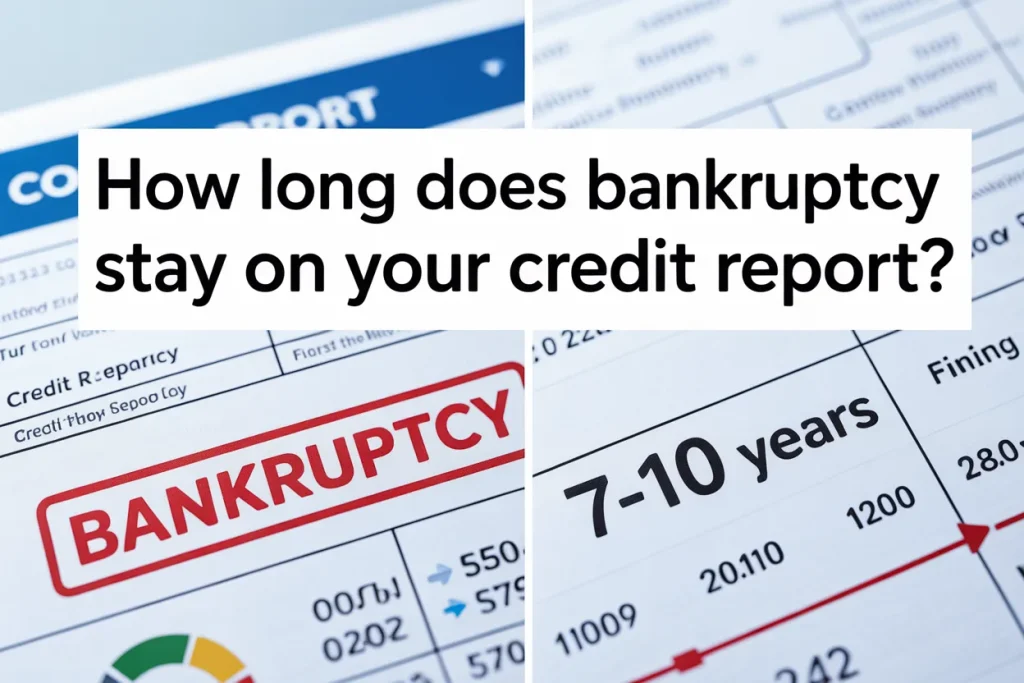
How Long Does Bankruptcy Stay on a Credit Report?
The most important thing to know is that not all bankruptcies are the same. In the United States, there are two main types for individuals. Each one stays on your credit report for a different amount of time.
Chapter 7 Bankruptcy
Chapter 7 is the most common type of bankruptcy. It is often called “liquidation.” In this process, a court might sell some of your extra property to pay off debt. In return, most of your debts are completely erased.
Because it wipes out debt quickly, it stays on your credit report for a longer time. Chapter 7 bankruptcy stays on your credit report for 10 years.
Chapter 13 Bankruptcy
Chapter 13 is different. It is often called a “wage earner’s plan.” In this process, you do not wipe out debt immediately. Instead, you create a plan to pay back some or all of your debt over 3 to 5 years.
Because you are making an effort to pay back what you owe, the penalty is shorter. Chapter 13 bankruptcy stays on your credit report for 7 years.
Quick Reference Table On How Long Does Bankruptcy Stay on Your Credit Report
Here is a simple chart to help you remember the time limits.
| Type of Bankruptcy | How Long It Stays on Credit Report |
|---|---|
| Chapter 7 | 10 years |
| Chapter 13 | 7 years |
When Does the Bankruptcy Timer Start?
This is a very common point of confusion. Many people think the timer starts when the case is closed (discharged). That is incorrect.
The clock starts ticking on the filing date.
The filing date is the day you first submit your paperwork to the court. It does not matter how long your court case takes to finish. The 7-year or 10-year countdown begins on day one.
A Real-Life Example:
Imagine you file for Chapter 7 bankruptcy on January 1, 2020.
Even if your case isn’t finished until June 2020, the 10-year clock started in January.
This means the bankruptcy should fall off your report in January 2030.
Does Bankruptcy Affect Credit Score the Whole Time?
Having a bankruptcy on your report will lower your credit score. However, it does not hurt your score the same way for the whole time.
The impact changes as time goes on:
- The Early Years (Years 1-2): This is when the damage is the worst. Your score will drop significantly right after you file. It tells lenders that there was a major financial problem recently.
- The Middle Years: As time passes, the bankruptcy matters less. If you start paying your new bills on time, your score can start to creep back up.
- The Later Years: By the time the bankruptcy is about to fall off, it has very little effect on your score. Lenders care much more about what you have done in the last 2 years than what happened 9 years ago.
You can start rebuilding your credit immediately after your case is closed. You do not have to wait for the bankruptcy to disappear to have good habits.
Can Bankruptcy Be Removed Early from a Credit Report?
You might see ads online that say, “We can remove your bankruptcy fast!” You should be very careful with these claims.
Generally, the answer is no. You cannot legally remove a bankruptcy from your credit report before the time limit is up. The credit bureaus are required to report accurate information. If you really filed for bankruptcy, it is accurate information.
There is only one exception:
If there is a mistake.
If the bankruptcy on your report is not yours, or if the dates are wrong, you can dispute it. If the credit bureau sees that it is an error, they must remove it. But if the information is correct, it must stay there for the full 7 or 10 years.
How to Check If Bankruptcy Is Still on Your Credit Report
It is a good idea to check your credit report once a year. This helps you see if the bankruptcy is listed correctly and if it falls off when it should.
Here are the simple steps to check:
- Go to the official website. You can get free reports from AnnualCreditReport.com
- Request your reports. You should look at reports from the three major bureaus: Experian, Equifax, and TransUnion.
- Look for the “Public Records” section. This is usually where bankruptcies are listed.
- Check the dates. Make sure the “filing date” is correct.
- Check the status. It should say “discharged” if your case is finished.
If the time limit has passed (7 or 10 years) and the bankruptcy is still there, you should file a dispute with the credit bureau to have it taken off.
What Happens After Bankruptcy Falls Off the Credit Report?
The day your bankruptcy falls off your report is a big milestone. It is like crossing a finish line.
When this happens, the reference to your bankruptcy disappears completely. Lenders who pull your credit report will no longer see it.
Here is what typically happens:
- Your score goes up. You might see a jump in your credit score.
- You get better offers. Banks and credit card companies may offer you lower interest rates.
- Approvals are easier. Getting approved for a mortgage or a car loan becomes much simpler.
It is a fresh start for your financial reputation.
FAQs Section
Here are answers to some common questions people ask about How Long Does Bankruptcy Stay on Your Credit Report
Does bankruptcy ever fully disappear?
Yes. Once the 7 or 10 years are up, the credit bureaus must delete it from your report. It does not stay there forever.
Can lenders still see old bankruptcy?
For most loans, no. After it falls off your report, lenders cannot see it. However, if you apply for a very large loan (usually over $150,000) or a job with a high salary, background checks might still find it in public court records.
Is Chapter 13 better than Chapter 7 for credit?
Both hurt your credit score significantly. However, some lenders look slightly more favorably on Chapter 13. This is because it shows you paid back some of your debt rather than erasing it all. It also falls off your report 3 years sooner than Chapter 7.
Conclusion
Bankruptcy is a tough decision, but it is not the end of your financial life. It is a legal tool designed to help people start over.
While it does stay on your credit report for 7 or 10 years, the impact gets smaller over time. You don’t have to wait a decade to have good credit again. By building good habits now, like paying bills on time and keeping debt low, you can improve your score while you wait for the bankruptcy to fall off.
Remember, the clock is ticking. Every day brings you closer to a clean slate.